Algorithm
Preprocessing
First of all, for ease of working with time series, we quantize its values
over a certain interval within which we want to trust the predictions.
In our case it is 300ms. During the quantization process, we leverage
various aggregation functions to retain essential information from the
original time series. This approach ensures that the resulting quantized
data encapsulates relevant characteristics of the underlying trends and patterns.
This part is solved with the function preprocessing_utils.quantize_table().
The basic version of the algorithm - working with a single time series
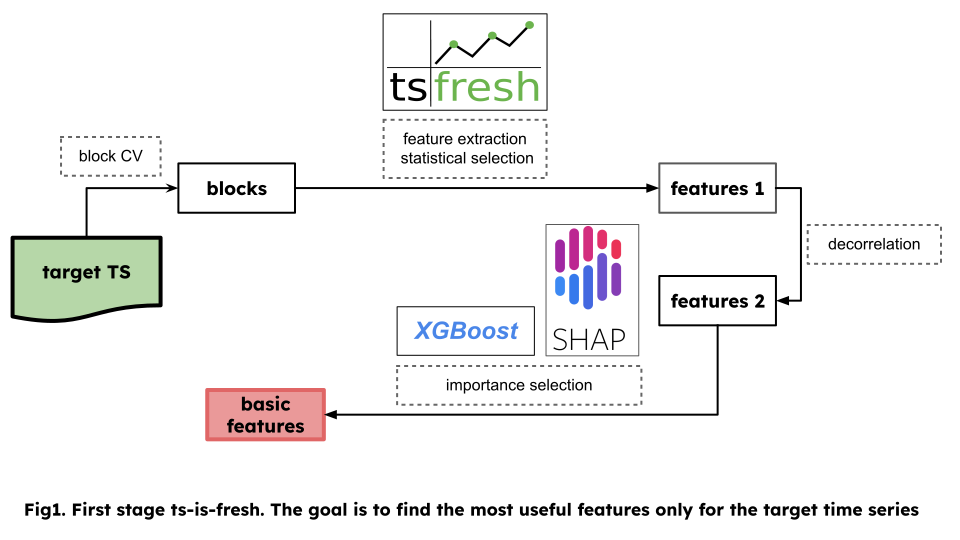
Feature creation. In order to generate statistical features using the tsfresh library, we
employ a windowing technique. This involves selecting a specific number
of neighboring points from the past for each point in the time series.
Within each window, we can extract a wide range of statistical functions
such as criteria statistics, asymmetry measures, quantiles, medians, and more.
By considering these diverse functions, we capture valuable insights and
characteristics from the time series data, enabling us to derive meaningful
statistical features for further analysis and modeling.
This part is solved with the extraction_utils.bcv_extract_features() ans tsfresh lib.
Statistical selection. After that, using statistical criteria, we will select among the constructed features only those that have great statistical significance in predicting the target value. This will allow us to narrow the dimensionality of the feature space for the first time (in practice, from 800 to 100 features). Here we can group the features with similar names under the assumption that such features are correlated. Only one best representative feature was left from each group.
Statistical significance is obtained using method selection_utils.get_stats()
Feature factorization. Since there are quite a lot of features selected by
statistical methods, it was decided to add feature importance selection. But we can’t do that,
because that our features may be strongly correlated features, in which case their
significance may be wrong. Since tsfresh computes a large number of similar features with
different hyperparameters, we need to find correlated ones. To do it,
we factorize all the features into the functions from which they were derived. And within each class we leave only the
representative with the highest p_value. After that we will count feature importance on the remaining
representatives.
The selection of the best uncorrelated features is obtained using selection_utils.stats_select_features().
Importance based selection. On the selected uncorrelated features, we will
train several XGBR models. Then for each of them we will count 6
types of feature importance (including shap values). By normalizing and averaging the
obtained values, we can rank the features according to their importance.
By selecting features whose total importance reaches 80%, we get the final set*!
This part is solved with the functions selection_utils.get_importance(),
selection_utils.importance_select_features().
Advanced version of the algorithm - take into account the context
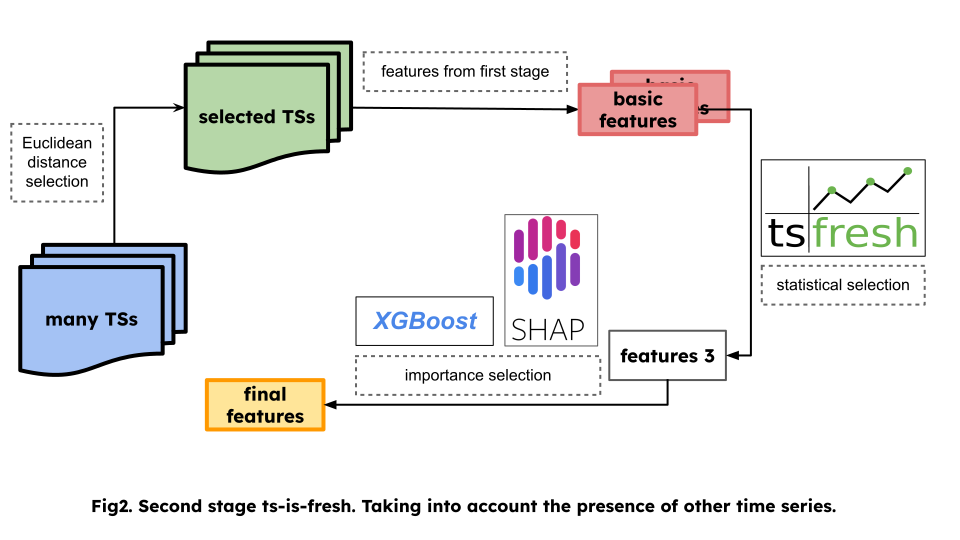
Finding most relevant external information. In real-world scenarios, numerous currencies are actively traded, and we can leverage this information in our analysis. However, considering all currencies simultaneously would lead to an excessively large number of parameters, making the task computationally challenging. Therefore, we employ a selection process to identify the top 10 currencies that exhibit the highest correlation with the target currency. To quantify correlation, we calculate the Euclidean distance between the vectors of percentage price changes. This allows us to identify the currencies that are most closely aligned with the target currency’s price movements.
Features aggregation. After that, for each of the currencies, we calculated the features that were selected for the target currency in the previous step. Combined the information obtained into one large table. And run the cycle of selection again, as in the case of a single time series. At the output, we get features selected statistically and with the help of importance values, calculated both for the target currency and for others!